Short answer
Penn State Extension says a fence meant to keep deer out of a whole yard should be at least 7 ft tall, but Upper Dublin, Lower Gwynedd, Cheltenham, Whitemarsh and Montgomery Township cap residential fences at 6 ft in the yards that matter. A few municipalities allow more: Lansdale up to 8 ft if the part above 6 ft is open, Upper Gwynedd 6 ft 6 in, and Horsham 6.5 ft if the whole fence is at least half open. Elsewhere, fence a smaller garden area, seek a variance, or pair a 6 ft fence with local deer management.
How bad is the deer problem here?
Bad enough that several townships keep count. Whitpain Township, which covers most of Blue Bell, logged 884 deer-related incidents over five years, about 176 a year, and 153 in 2022 alone, including one fatality. Its Shade Tree Committee reported in 2021 that deer browsing had caused "arrested succession" in the woods near Center Square Park, meaning young trees weren’t surviving to replace old ones.
Upper Dublin started a police-run deer management program as a pilot in 2009; by 2013 officers had answered more than 680 deer calls in six and a half years, each taking about 30 minutes. Montgomery County has run an archery and crossbow hunt at Lorimer Park in Abington since 2002 at neighbors’ request. And there’s the tick side of it: Montgomery County recorded 606 Lyme disease cases in 2016 and 7,393 from 2000 to 2016.
How tall does a deer fence need to be?
Penn State Extension’s Jim Sellmer puts it at a minimum of 7 ft for a fence around a whole yard. Lower fences slow deer down; a determined deer clears them. That’s the problem in most of our area, because local codes were written for privacy fences, not deer fences.
What your township allows
| Municipality | Maximum in side and rear yards | Room for a taller, open top? |
|---|---|---|
| Upper Dublin (Dresher, Fort Washington, Ambler area) | 6 ft within required yard setbacks | No; over 6 ft not allowed in required setbacks |
| Lower Gwynedd (Gwynedd, Spring House) | 6 ft in any required yard | No |
| Whitemarsh (part of Blue Bell, Lafayette Hill) | 6 ft | Only up to 10 ft around tennis courts, playgrounds or other recreation areas, non-opaque, with extra setback |
| Cheltenham | 6 ft | No |
| Montgomery Township | 6 ft for boundary fences | No |
| Abington | 6 ft without a Zoning Hearing Board special exception | The building code exempts open wire fences from its 6 ft limit; the zoning ordinance’s fence section couldn’t be read, so this is unconfirmed |
| Upper Gwynedd | 6 ft 6 in | Higher needs a ZHB special exception |
| Horsham (part of Maple Glen) | 6.5 ft | A fence over 6 ft must be at least 50% open over its whole area |
| Lansdale Borough | 6 ft | Up to 8 ft total if the part above 6 ft is not opaque |
| Towamencin | 6 ft | Taller only where the part above 6 ft is at least 4 parts open to 1 part solid |
| Whitpain (most of Blue Bell), Lower Moreland, Bryn Athyn | Not verified by us | Confirm with the municipality |
Checked October 2026 from the codes listed under Sources. Front-yard limits are lower everywhere.
Notice the pattern: where a township allows a fence over 6 ft, it wants openness. In Lansdale only the part above 6 ft has to be open, so a deer-oriented design there might be a 6 ft fence with an open mesh or wire extension above it. In Horsham the whole fence has to be at least half open, so a solid fence with a topper doesn’t qualify; an open picket or wire design does. In Lansdale, keep in mind that fences made exclusively of wire are banned, so the extension has to sit on a real fence below it.
Option 1: fence the garden, not the yard
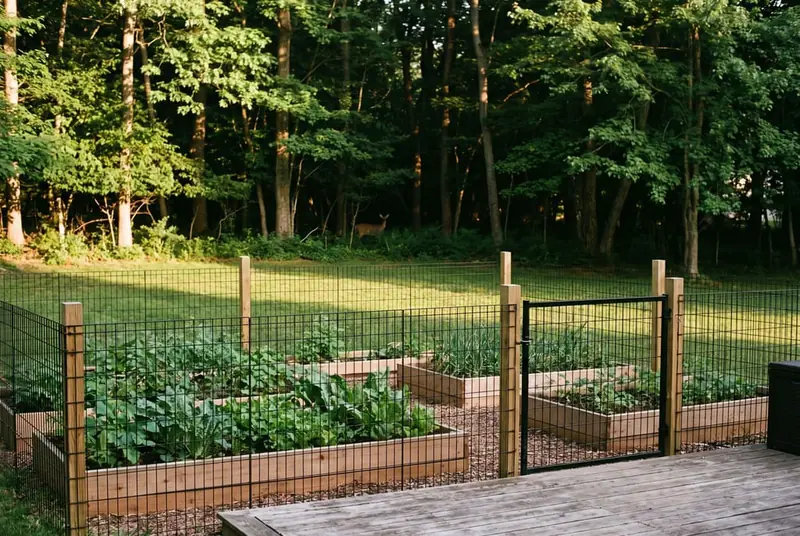
Most deer complaints are about a vegetable garden, a young orchard or a bed of hostas, not the whole lot. A smaller enclosure costs far less, is easier to close up with gates, and keeps deer away from what they actually eat. Several codes word their height cap as applying within required yards, the setback strips along the lot lines. Ask the zoning officer whether a garden enclosure set back inside your buildable area is treated differently before you assume it is.
If rabbits and groundhogs share the garden, add a band of small mesh at the bottom. Penn State’s spec for rabbit fencing is at least 24 in high, with no opening larger than 1 in, buried 2 to 3 in.
Option 2: ask for a variance
You can ask your Zoning Hearing Board for permission to exceed the height limit. Two local records show how that goes. In November 2019 a homeowner on Inverness Lane in Huntingdon Valley asked Lower Moreland’s board for a variance to build an 8 ft deer fence around the front, side and rear yards, citing Lyme disease. In 2021, Upper Merion’s board, also in Montgomery County, unanimously denied an 8 ft ornamental steel deer fence where 6 ft was the maximum. It found that keeping deer out is a personal preference, not the kind of hardship a variance requires.
A variance is a legal process with notice, a hearing and a written decision. If you’re considering one, talk to a Pennsylvania land-use attorney. This guide isn’t legal advice, and we can’t predict how a board will rule.
Option 3: work with local deer management
A 6 ft fence plus fewer deer in the neighborhood often does more than a taller fence alone. All of Montgomery County is in the Game Commission’s Southeast Special Regulations Area, and Wildlife Management Units 5C and 5D have an extended antlerless season from Dec. 26 to Jan. 28. Upper Dublin’s program has held hunts on township land such as Pine Run Park and Robbins Park. In Whitpain, homeowners can waive the 50-yard archery and 150-yard firearm safety zones on their own land, and add their own restrictions.
Choosing materials for a deer-pressure yard
- Aluminum or steel picket, 5 to 6 ft: lasts, looks finished from the street and keeps the view. Deer can see through it, which some homeowners like and some don’t.
- Wood or vinyl privacy, 6 ft: gives privacy and blocks the view into the garden, but it’s the heaviest wind load of any option. In Lansdale an open topper can take it to 8 ft.
- Welded wire on wood posts: the classic garden-enclosure fence. Check the rules first: Upper Moreland prohibits wire fences, and Lansdale bans fences that are exclusively wire.
- Electric: not an option on most residential lots. Montgomery Township allows electric fences only for agricultural uses, and Horsham allows them only for agriculture on lots over 10 acres, invisible pet fencing excepted.
Deer fencing is one place where a site visit changes the answer. At the free estimate we look at where the deer actually come in, what you’re protecting and what your township allows, and we’ll tell you honestly if a 6 ft fence won’t solve it.
Common questions
Will a 6 ft fence keep deer out at all?
It helps, especially around a small garden or a solid privacy fence, but Penn State’s guidance for whole-yard deer fencing is at least 7 ft. Expect fewer visits, not none.
Does a deer fence need a permit?
It’s a fence, so the same permit rules apply as for any fence in your municipality. Our mailing-address guide lists who issues permits.
Is plastic deer netting legal?
Many codes don’t address it by name. Upper Moreland prohibits wire fences and Worcester bans fences of fabric or junk materials, so ask the zoning office before relying on netting as your fence.