Short answer
In Montgomeryville and other North Penn planned communities, a fence often needs two approvals: the homeowners association’s, under its recorded covenants, and the township’s fence permit. Neither replaces the other. Montgomery Township’s permit process says HOA approval rules apply and requires the fence to sit at least 2 in inside the property line. Worcester’s application asks for the HOA approval letter. Get the association’s written approval first, then file the township permit.
Why so many North Penn homes have an HOA
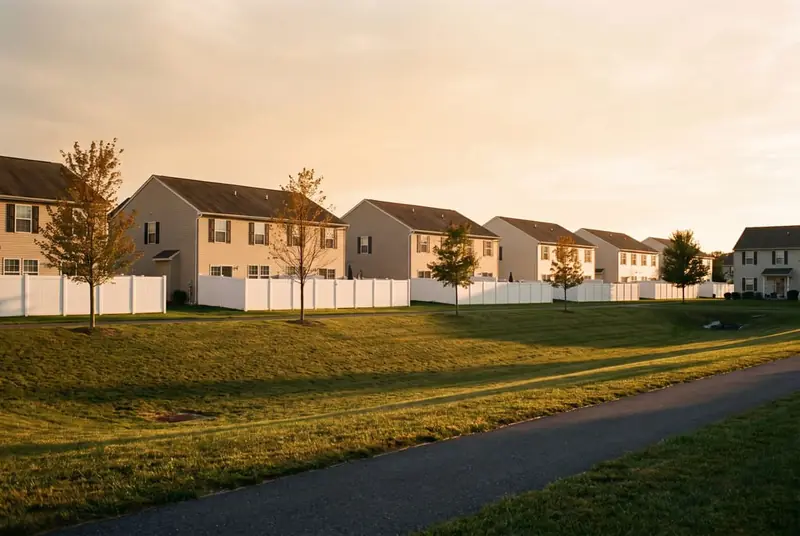
Montgomery Township is the largest municipality in the North Penn area. It had 3,936 residents in 1970 and 25,862 in 2020, and most of its homes are suburban houses on newer subdivision streets. Its villages include Montgomeryville and Montgomery Square, and US 202, Route 309 and Route 463 all cross the middle of the township. Towamencin, once farmland, is now largely suburban too, with about 18,000 people. Development on that scale usually comes with recorded covenants, shared stormwater basins and open space, which is where associations come in.
Two approvals, two rulebooks
| HOA (architectural review) | Township (fence permit) | |
|---|---|---|
| Based on | The community’s recorded declaration, covenants and rules | The township zoning code |
| Usually looks at | Style, color, material, height, location, how it looks from the street | Height by yard, setbacks, easements, sight lines, which side faces out |
| Can it override the other? | No. It can’t approve what the code forbids | No. A permit doesn’t cancel your covenants |
| When | First, so the design is settled | Second, with the approved design |
Each association’s documents differ. Read your own.
The two connect in a way that catches people. Lansdale Borough, for example, says that failing to disclose easements or deed restrictions on its fence application voids the approval. Restrictions recorded against your lot are part of the picture whether or not the township enforces them.
What Montgomery Township checks
Montgomery Township requires a permit for new or replacement fences, filed with the Planning & Zoning Office (215-393-6920) with a site plan showing the fence and its distances from the property lines. Its code (§ 230-148) covers a lot of what an HOA committee will also care about:
- Placement: boundary fences go within 5 ft of the property line, as close as possible without being on it. The township’s permit guidance says at least 2 in inside the line.
- Appearance: posts face inward, the more attractive side faces out, and no unusual colors or offensive designs on the outside.
- Front yards: no boundary fences unless the front yard is on a major street, where 4 ft is allowed. Decorative picket, stone or iron fences up to 3 ft are allowed anywhere on the lot.
- Privacy fences: up to 6 ft, in the rear only, inside the building envelope, and generally at least 5 ft from structures. One attached to a structure needs a gate at least 3 ft wide.
- Easements: fences in utility, stormwater or access easements are discouraged. If allowed, they need a signed fence easement agreement with the township, must be easy to remove, and carry an extra fee.
- Water: no fences in floodplains or wetlands, or where they interfere with stormwater flow.
- Extras: backyard chicken runs need permit approval and a fence at least 4 ft high; pool enclosures must be at least 4 ft, and pool permits carry a $1,200 curb escrow.
Worcester, Towamencin and Hatfield
Worcester Township builds the HOA step into its form. The fence permit application asks for the signed two-page application, two copies of the plot plan, an HOA approval letter if applicable, and written owner consent if someone other than the owner applies. A contractor adds proof of PA registration, liability insurance naming the township and workers’ compensation. Worcester also has a rule written for townhouse rows: where three or more connected homes fence their rear yards, a 48 in emergency accessway must run along the rear line, with 36 in gates.
Towamencin Township bars fences in any easement, any retention or detention basin, and the ultimate right-of-way of a street; a fence in an easement needs the easement owner’s written consent. Its residential application carries a $95 zoning fee (07/2026 form) and asks for two plot plans. In the township’s MRC Mixed Residential Cluster district, fences follow a separate subdivision rule (SALDO § 136-518).
Hatfield Township bars fences in any easement benefiting the township without written permission from that agency and the township.
Basins, open space and the strip behind your yard
Planned communities often have a stormwater basin, a walking path or common open space directly behind the back yards. That land usually belongs to the association, not to you, and the rules above often bar fencing into easements or basins anyway. Set the fence on your own side of the line.
Don’t count on time to change that. Pennsylvania’s 10-year adverse possession rule for small residential lots (42 Pa.C.S. § 5527.1) doesn’t apply to land within a planned community. This is general information, not legal advice; a Pennsylvania real-estate attorney can tell you how the law applies to your lot.
What an HOA committee usually wants to see
Each association sets its own requirements, but a complete request usually includes:
- A plot plan or survey with the fence line, gates and distances drawn on it.
- The style, height, color and material, with a product photo or brochure page.
- Which side faces out, if the style has a good side.
- For a pool fence, the gate hardware and latch height.
We can put the drawing and product details together with your quote, so the same package goes to the association and, once approved, to the township.
The order that saves time
- Read your community’s declaration and any architectural guidelines.
- Get a quote with a dimensioned drawing and product specs.
- Submit to the HOA and get written approval.
- File the township permit, attaching the HOA letter where the township asks for it.
- Request PA One Call (811) at least 3 business days before digging.
- Install. Most residential fences take one to three days on site.
- Call for any final inspection the township requires.
Tell us your community’s name when you book the free estimate. If you already have the association’s guidelines, send them along and we’ll design to both rulebooks from the first drawing.
Common questions
My HOA approved a 6 ft fence along the street side. Does that mean the township will?
No. The HOA can’t approve something the zoning code doesn’t allow. In Montgomery Township, nothing over 4 ft goes in a front yard, and a corner lot’s street side may count as a front yard.
The township issued my permit, but the HOA says no. Can I build?
A township permit doesn’t cancel your covenants, and associations can usually enforce their documents. Resolve it with the association first, and talk to a Pennsylvania real-estate attorney if it turns into a dispute.
Do I need HOA approval to replace an old fence with the same thing?
Check your association’s rules; many want to see replacements too. Montgomery Township requires a permit for replacement fences, not just new ones.