Short answer
Generally yes, up to the property line. Pennsylvania law lets you trim a neighbor's branches where they hang over your side, but the right stops at the line, and a tree whose trunk stands on the line belongs to both owners. In Glenside, Wyncote and Elkins Park, where mature trees overhang most back fences, talk to your neighbor before you cut. This is general information, not legal advice.
What Pennsylvania law lets you cut
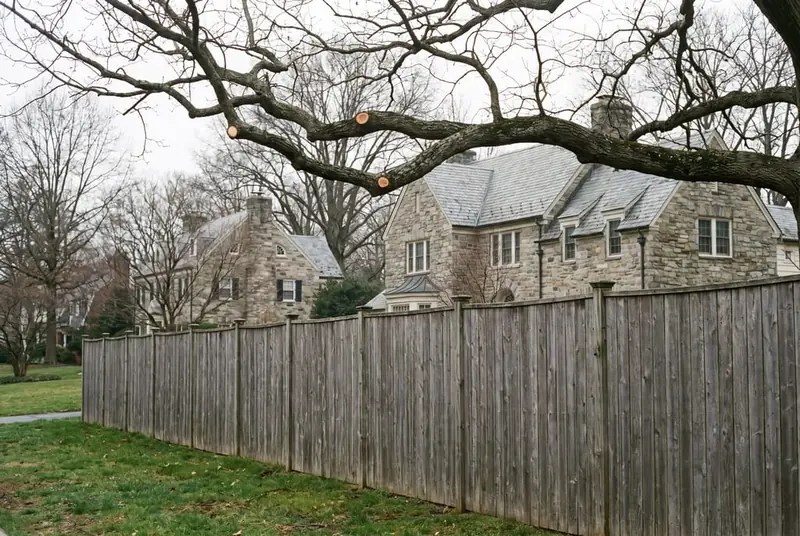
FindLaw's summary of Pennsylvania property-line law puts it simply: you may trim a neighbor's overhanging limbs back to the property line. The right covers branches over your yard. It doesn't let you step onto the neighbor's land to make the cut, and it says nothing that would let you take the tree down.
A tree whose trunk sits on the line is different. Pennsylvania treats a boundary tree as owned by both neighbors, so neither one should remove it or cut it hard without the other's agreement. If you aren't sure where the trunk sits relative to the line, that's a survey question before it's a pruning question.
Why this comes up so often in Glenside and Wyncote
Cheltenham's housing mixes historic homes, twins, split-levels and rowhouses, and the Wyncote Historic District alone covers more than 100 acres with 178 contributing buildings. Elkins Park, split between Cheltenham and Abington, is known for close-set Tudor, Queen Anne and Dutch Colonial houses. Old houses on close lots usually come with old trees whose crowns cross the line.
Those limbs are what land on fences. The Feb. 5, 2014 ice storm was PECO's second most damaging storm on record, with more than 180,000 Montgomery County customers out, mostly from falling limbs. During Ida in 2021, a falling tree killed a woman in her Upper Dublin home. Overhanging wood is worth dealing with before it comes down on its own.
Trimming before a new fence goes in
- Find the line. Use your survey or property pins; an old fence or hedge isn't proof of where the line is.
- Mark where the posts and panels will stand, and how much head room a 6 ft privacy panel needs under the branches.
- Talk to the neighbor first, and follow up in writing about what will be cut and who is hiring the arborist.
- Have large limbs taken down by a tree service before the fence crew arrives, so nothing drops on new panels.
- Leave room for growth. A branch that just clears the fence this fall can rest on it in two summers.
On wooded lots further out, the same planning feeds the permit. Lower Gwynedd's fencing checklist asks for plans that show every tree 6 in or more in diameter within 50 ft of the work, and its floodplain rules bar removing trees or vegetation within 20 ft of a stream bank. If your fence line runs near a creek, check before anything is cut.
Roots along the fence line
Branches are only half of it. Big trees near the line leave roots right where posts want to go. When an auger hits a large root, we would rather shift the post a few inches or adjust the panel layout than sever a root that feeds a tree you or your neighbor value.
When you and the neighbor don't agree
Keep it factual: photos of the overhang, the date, what you asked for and what you were told. If a dispute over a tree or the line itself starts to involve money or a threat of a lawsuit, talk to a Pennsylvania real-estate attorney about your situation. We can tell you what a fence needs; we can't tell you who wins a property dispute.
When we come out for your free estimate, we walk the line with you and flag the limbs and roots that will get in the way of posts and panels, so the tree work can be sorted out before the install date.
Common questions
Can I cut down a tree that's right on the property line?
A tree whose trunk stands on the line is treated as owned by both neighbors in Pennsylvania. Don't remove it or cut it heavily without your neighbor's written agreement, and talk to an attorney if you can't agree.
Does the Wyncote historic district restrict tree trimming?
Cheltenham's historic-district rules treat changes to fences, walls and trellises in Wyncote and La Mott as alterations that need Board of Historical Architectural Review approval. Our research didn't cover tree work, so ask the township before major cutting there.
What if the branches fall on my fence anyway?
Start with your own homeowners policy. See who pays when a tree falls on your fence for what to document.