
Short answer
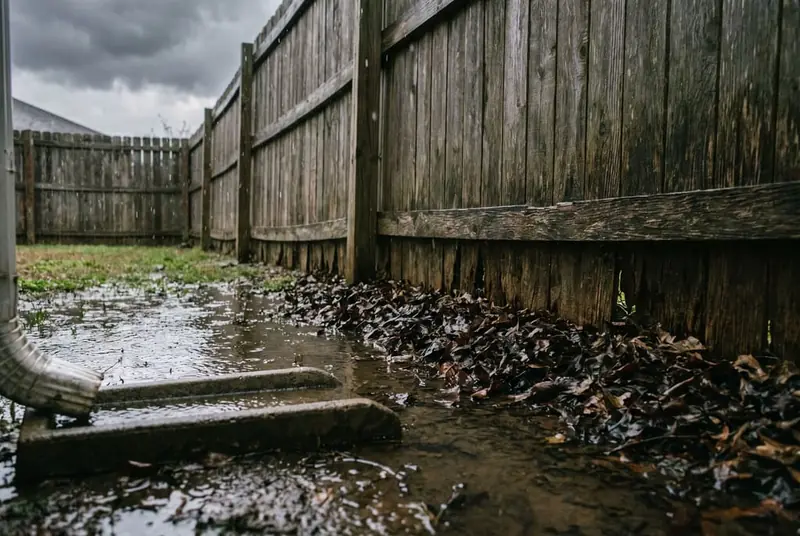
It can. A solid privacy fence built tight to the ground acts like a low dam: sheet flow and leaves pile up against it, and water backs up into your yard or gets pushed toward a neighbor's. Cheltenham, Upper Moreland and Montgomery Township prohibit fences that block stormwater flow. On a wet lot, leave a gap at the bottom, run solid sections parallel to the water's path, and use open styles where water crosses.
How a fence changes where water goes
Rain that runs off a lawn moves as a thin sheet toward the low side of the lot. An open fence barely notices it. A solid board or vinyl fence set right at grade stops it, and within a season the bottom of the fence collects a strip of leaves and mulch that makes the seal tighter. Water then ponds against the fence, finds the one low gap, or runs along the fence line to a corner. Your fence can change where your neighbor's water goes, which is exactly why some townships regulate it.
Why wet yards are common here
Much of the North Penn shale belt has Croton and Readington soils with a fragipan 15 to 36 in down that perches water in late winter and spring, so yards stay soggy long after a storm. Further east, Cheltenham has a long history of flooding along Tookany Creek; a 2015 Army Corps report tied higher runoff to urbanization, and some Elkins Park residents built stone walls after repeated floods. In Ida, the Wissahickon gauge at Fort Washington State Park reached 17.74 ft (the creek leaves its banks at about 12 ft), and the low-lying Fort Washington Office Park floods badly enough that a 2022 state grant paid to replace the Bodenstein Channel culvert.
What local codes say about fences and water
| Municipality | Rule |
|---|---|
| Cheltenham Township | No fence in floodplains, swales or watercourses; no fence may block stormwater flow from the site or an adjoining property |
| Upper Moreland Township | Same floodplain, swale and stormwater-flow rule |
| Montgomery Township | Fences prohibited in floodplains and wetlands, and where they interfere with stormwater flow |
| Whitpain Township (Blue Bell) | In the floodplain district, fences parallel to water flow are allowed; fences across the flow must be open post-and-two- or three-rail, optionally with welded wire mesh no smaller than 2 x 4 in, with plans approved first |
| Lansdale Borough | No fences in the floodplain district, even by special exception (§ 405-2604A) |
| Lower Gwynedd Township | Fences aren't a permitted use in the floodplain conservation district |
| Abington Township | About 3 in of ground clearance for solid board fences has been reported, but we didn't find it in the code text we read. We confirm with the township. |
Checked October 2026 from the cited code. Codes change; we confirm with the zoning office before every install.
How we build privacy on a wet lot
- Leave a gap of a few inches under solid panels so sheet flow passes, sized with your dog in mind.
- Step panels down a slope instead of burying the low end of each one.
- Run solid sections parallel to the way water moves; switch to aluminum, split rail or picket where the fence must cross the flow line.
- Set posts in concrete below the 36-in frost benchmark, since wet ground is where posts heave first.
- Keep gates out of the lowest spot, where ponding and ice make them stick.
When the answer is to not fence that strip
If the low corner of the yard is a mapped floodplain, a recorded drainage easement or a swale, the code may decide for you. Even where it doesn't, a fence that crosses the one path water has to leave the neighborhood is a fence that gets knocked over or clogged in the next big storm. Ending a run short of the low spot, or closing it with a removable section, is often the better design.
Walk the yard with us after a good rain if you can. We'll show you where a solid fence will work and where it should open up.
Common questions
Will a gap under the fence let my dog out?
A few inches stops most dogs. For diggers or very small dogs, we can add a buried wire barrier on the inside of the fence line, where the township allows it.
Is my yard in a floodplain?
Ask your township's zoning office; floodplain districts are mapped. Our guide to floodplain fences along the Wissahickon, Sandy Run and Tookany covers the creeks here.
Does a board-on-board fence let more water through?
No. It blocks sight and water about as fully as a solid fence. The gap at the bottom is what lets water pass.