
Short answer
Abington, Cheltenham, Upper Dublin and Montgomery Township each require a pool barrier at least 4 ft (48 in) high. Abington is the most specific: no more than 2 in of clearance at grade, no opening that passes a 4 in sphere, and gates that open outward and self-close and self-latch. Upper Dublin wants a separate $50 fence permit and door alarms where the house is part of the barrier. Cheltenham requires a locking gate, and Montgomery Township a 4 ft enclosure plus a $1,200 curb escrow on the pool permit.
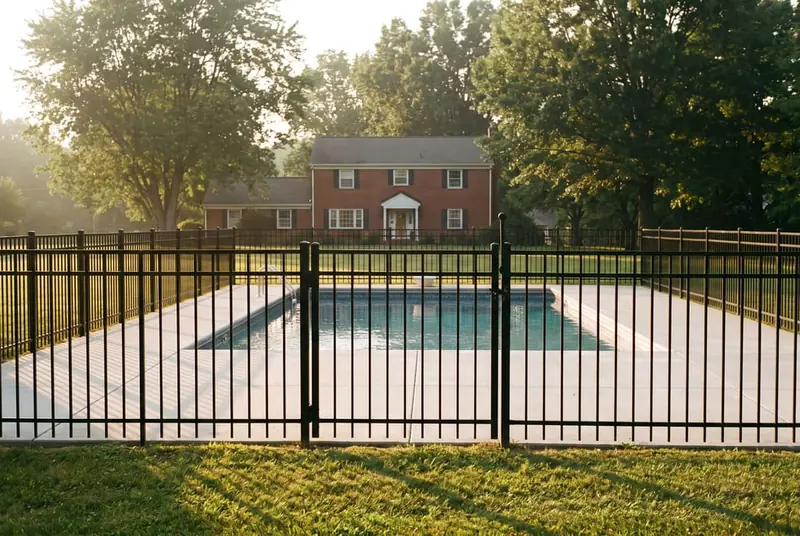
The four townships at a glance
| Township | Minimum barrier | The rule that most often catches people |
|---|---|---|
| Abington (Abington, Roslyn, parts of Glenside and Willow Grove) | 48 in | Gates must open outward, away from the pool; in-ground pools need an engineered plot plan |
| Cheltenham (Glenside, Elkins Park, Wyncote) | 4 ft with a locking gate | Fence material must be approved by the Building Inspector |
| Upper Dublin (Dresher, Fort Washington) | 4 ft, on the ground or on top of an above-ground pool | A separate $50 fence zoning permit on top of the pool permit |
| Montgomery Township (Montgomeryville) | 4 ft on all sides | $1,200 curb escrow with the pool permit |
Checked October 2026 from the township documents listed under Sources. Your inspector has the final word.
Glenside is split between Cheltenham and Abington, so two neighbors on the same street can have different pool paperwork. Check which township your lot is in before you plan the fence.
Abington: the most detailed pool rules in our area
Abington’s rules come from three places: the township’s Swimming Pool Requirements sheet, its Swimming Pools chapter (Ch. 149) and its building code (§ 421.9). Together they cover nearly every part of the barrier.
Height, gaps and gates
- Top of the barrier at least 48 in above grade.
- No more than 2 in of clearance between the bottom of the barrier and the ground.
- No opening large enough to pass a 4 in sphere.
- Pedestrian gates open outward, away from the pool, and are self-closing and self-latching. A latch release lower than 54 in goes on the pool side.
- Every gate needs a lock satisfactory to the Building Inspector, and no outside horizontal rail can serve as a foothold (Ch. 149, for pools holding more than 2 ft of water within 300 ft of a property line).
Materials
- Wood pickets of at least 3/4 in stock, spaced no more than 2 in apart.
- Iron or aluminum pickets at least 1 in square, spaced no more than 4 in apart.
- Wire fencing must be chain link, 11 gauge or heavier.
- Solid enclosures no taller than 6 ft.
- Natural barriers and pool covers don’t count as the enclosure.
House walls, above-ground pools and spas
The house can be one side of the barrier if the doors into the pool area have alarms (sounding for at least 30 seconds as soon as the door opens and resetting automatically) or the pool has an ASTM F1346 power safety cover. An above-ground pool’s wall can serve as the barrier if its steps or ladder lock, come off or are enclosed; a fence mounted on top of the wall can leave no more than 4 in of gap. Spas with an ASTM F1346 cover are exempt from the barrier rule.
Where the pool can go
Abington wants the pool 10 ft from side and rear lot lines, out of any swale, out of the required front yard, and not within 10 vertical ft of power lines. Pools count toward impervious cover. In-ground pools need an engineered plot plan, and the permit application must show how the pool will be fenced and latched.
Cheltenham: 4 ft and a locking gate
Cheltenham requires every pool to be completely enclosed by a fence at least 4 ft high with a locking gate, and the fence material has to be approved by the Building Inspector. One exception: a pool with an elevated platform or walkway at least 4 ft above the ground doesn’t need a separate fence if its ladders or steps can be locked or removed.
Cheltenham’s general fence rules still apply to the pool fence: up to 6 ft in side and rear yards, the finished side facing neighbors, and no fences in floodplains, swales or watercourses. That last rule matters for yards near Tookany Creek.
Upper Dublin: two permits and a ladder rule
Upper Dublin’s pool permit guide sets the barrier at 4 ft minimum, either on the ground or on top of an above-ground pool. It adds:
- A separate fence zoning permit, $50 on the township’s 2021 price list, alongside the pool permit.
- If the fence sits on top of the pool, a collapsible ladder with a latch.
- If the house forms part of the barrier, alarms on the doors into the pool enclosure.
- Above-ground pools set back 10 ft from all property lines and structures.
- The finished side of the fence, without the structural supports, facing neighboring properties (§ 255-24).
Upper Dublin takes permits only through its online OpenGov portal, and a contractor has to complete the township’s Contractor Registration before a permit can be submitted.
Montgomery Township: enclose it on all sides
Montgomery Township’s code (§ 230-153) requires a pool to be enclosed on all sides by a fence, wall, gate or building at least 4 ft high. The pool permit needs a site plan showing the pool and its fence, plus a $1,200 curb escrow. A pool can use reduced setbacks if it’s screened by a buffer or by an opaque fence 5 to 6 ft high (§ 230-149B(1)(b)), which makes a privacy fence do double duty. In a planned community, get the HOA’s approval for the fence too.
Choosing a pool fence that passes everywhere
Building to the strictest of these rules covers most of what all four townships ask for, though your inspector still has the last word:
- Aluminum picket with pool-spec spacing (no more than 4 in) is the most common choice; it keeps the view of the pool open for supervision. Our installed price guide for 4 to 5 ft aluminum is $50 to $85 per foot.
- Vinyl privacy, $45 to $75 per foot at 6 ft, works well where neighbors are close; keep horizontal rails on the pool side so they can’t be climbed from outside.
- Chain link is the budget option; in Abington it has to be 11 gauge or heavier, and small mesh helps meet the 4 in sphere test.
- Gates are where inspections fail. Plan outward-swinging, self-closing, self-latching gates with the latch release up high or on the pool side.
Pool fences are the one project where we’d rather over-plan. At the free estimate we’ll walk the pool layout, mark the gate swings and latch heights, and check your township’s sheet before anything is ordered.
Common questions
Can my house wall be one side of the pool barrier?
In Abington, yes, with door alarms or an ASTM F1346 power safety cover; Upper Dublin also requires door alarms. More in our house-wall answer.
Does a hot tub need a fence?
Abington exempts spas that have an ASTM F1346 safety cover. Other townships vary; see our hot tub answer.
Can I put the pool fence on top of my above-ground pool?
Upper Dublin allows the 4 ft barrier on top of the pool with a collapsible, latching ladder. Abington allows it if the gap between the fence and the pool wall is 4 in or less.