
Short answer
Only with your neighbor's permission, and even then we usually advise against it. Their fence is their property, so fastening to it ties your fence to their posts, their repairs and their decision to take it down. On the tight twin and rowhome lots of Jenkintown, Glenside and Roslyn, the cleaner fix is to set your own end post a few inches inside your line and close the gap there.
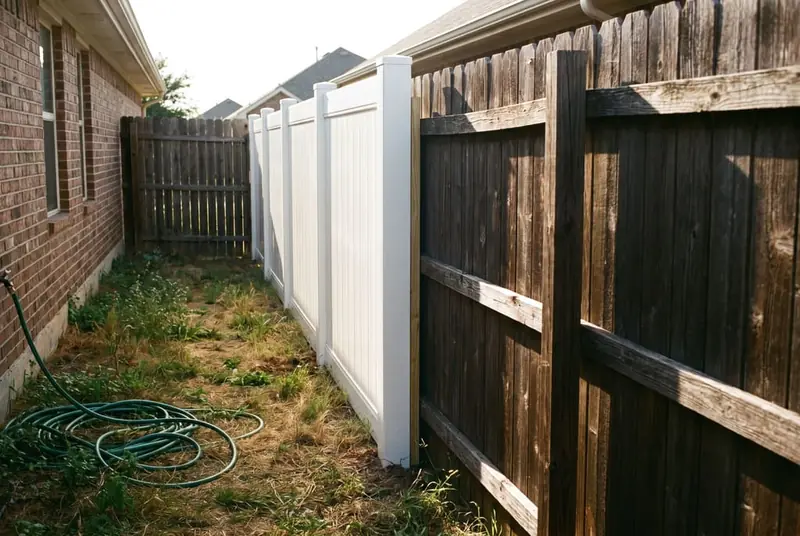
Why tying into a neighbor's fence causes trouble
- Their post carries your load. A gate swinging off a neighbor's post, or a run of solid panels catching wind, pulls on a post you don't own and can't reset.
- Their fence can disappear. If they replace or remove it, your run ends in mid-air, and a dog run or pool barrier that relied on it is suddenly open.
- Different heights and materials rarely line up. A 6 ft vinyl panel butted to a 5 ft stockade fence leaves an awkward step and a gap for small dogs.
- The line is usually right there. Most neighbor fences sit at or near the property line, so tying in means building on the line too. Several townships here have rules about exactly that.
What the local codes say about building near the line
| Municipality | Placement rule we found |
|---|---|
| Cheltenham (Glenside, Wyncote, Elkins Park) | Fence no more than 5 ft from the property line, if the line is clearly established and the strip between fence and line stays accessible and maintained by the owner. Finished side faces neighbors (§ 295-405A(6)). |
| Abington (Roslyn, Rydal, part of Glenside) | A fence on or within 5 ft of a property line needs a building permit, and the permit needs evidence of a boundary survey unless the Building Official can readily establish the line (§ 3311.2, § 3311.5). |
| Montgomery Township | Boundary fence at least 2 in inside the property line, as close as possible without being on it. |
| Jenkintown Borough | Not confirmed in our research. We check with the borough before quoting. |
Rules checked October 2026 from the cited code sections; codes change, so we confirm with the zoning office before every install.
Abington's survey rule matters most here. If the plan is to run your fence right up to a neighbor's, you are building within 5 ft of the line by definition, and the township will want to know where that line is.
Why this comes up so much in Jenkintown and Glenside
Jenkintown packs 4,719 people into 0.59 square miles, roughly 8,000 per square mile, with 2,214 housing units. Glenside is split between Cheltenham and Abington townships, so two houses on the same street can fall under different fence codes. On lots that tight, it's common to find an existing fence on one or two sides before you add a single post.
Better ways to close the gap
- Set your own end or corner post a few inches inside your line, next to the neighbor's post rather than on it.
- Match their height where your code allows, or step down with a transition panel so the change looks planned.
- Leave enough of a gap to paint, stain or repair either fence without taking the other apart.
- Photograph the neighbor's fence before work starts, so nobody argues later about a cracked rail.
- If you both want one shared fence instead, put the agreement in writing: who owns it, who maintains it, who pays for repairs.
If the neighbor's fence is on your side of the line
Sometimes the survey shows the old fence sitting on your land. That raises bigger questions than where to put an end post, including Pennsylvania's 10-year adverse possession rule for small residential lots. Read what happens when a neighbor's fence has been on your land for 10 years, and talk to a Pennsylvania real-estate attorney before you move or remove anything. This page isn't legal advice.
At the estimate we sketch exactly where your end posts land relative to the neighbor's fence and the line, so you can show your neighbor the plan before anyone digs.
Common questions
Can my new fence touch my neighbor's fence?
It can run close. Fastening to their posts or rails needs their permission. We normally leave a small gap with our own post, so each fence stands on its own.
What if my neighbor's fence is a different height?
Check your township's limit first; Cheltenham and Abington both cap side and rear fences at 6 ft. Then decide whether to match the neighbor's height or step down with a transition panel.
Do I need a survey to build next to a neighbor's fence?
In Abington, a fence within 5 ft of a property line needs boundary-survey evidence unless the Building Official can establish the line. See do I need a survey for a fence permit.