
Short answer
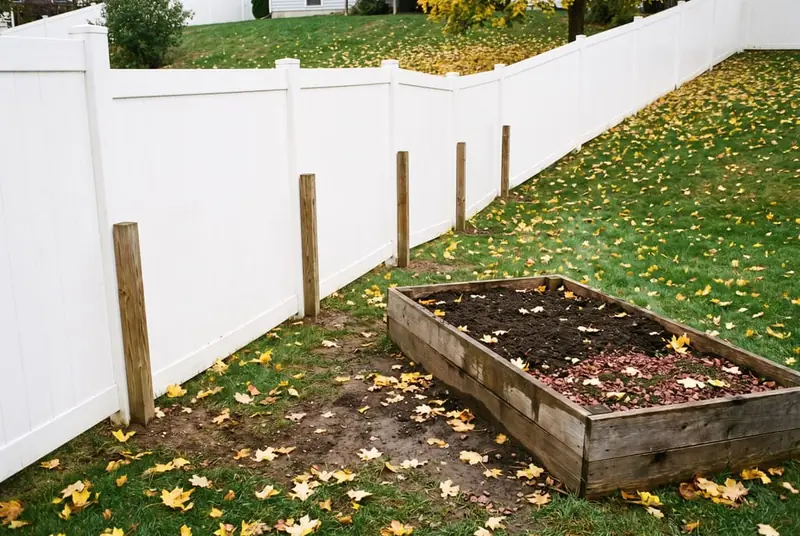
No. Lansdale Borough requires fences to be built at natural grade, not on berms or artificial mounds, and to be kept straight without sagging or leaning. A fence on top of a raised bed or a landscaped mound would not meet that rule. On a sloped Lansdale yard the fence follows the ground instead, with stepped or racked panels, and the 6-ft height limit is measured from that natural grade.
What the borough's rule says
The borough's fence permit packet and the placement rules in Zoning Chapter 405 say fences must sit at natural grade, "not on berms or artificial mounds," and must be kept straight without sagging or leaning. There is no exception in the material we read for a short berm or a decorative bed.
The practical effect is easy to see from next door. A 6-ft privacy fence on a 2-ft mound is a wall 8 ft above your neighbor's lawn. Building at natural grade keeps the borough's height limits meaning what they say: up to 6 ft solid in side and rear yards, or up to 8 ft total if the part above 6 ft is see-through.
What counts as natural grade on an older lot?
Lansdale grew up around the North Pennsylvania Railroad and was incorporated in 1872, and many of its lots have been filled, terraced or edged over the decades. If a mound or raised bed was built along your property line, the fence still goes at the level of the surrounding ground, not on top of the bed. When we are not sure whether a slope is original or built up, we note it on the site plan and ask Code Enforcement before we set posts.
Common situations we see
- A raised vegetable bed along the back line. Run the fence at lawn level behind or in front of the bed, not through the top of it.
- A berm planted with shrubs for privacy. Put the fence at the foot of the berm on the yard side, or go with plantings alone.
- A yard that slopes toward the neighbor. That is natural grade. The fence steps or racks to follow it.
- Fill dumped to level a low spot. Ask the borough before fencing on it.
Stepped or racked on a sloped Lansdale yard?
Because the fence has to follow the ground, slope is handled in the panels, not by building the ground up.
| Method | How it works | Best for |
|---|---|---|
| Stepped | Each panel stays level and drops down at each post, like stairs | Vinyl and board-on-board privacy fences |
| Racked | The panel tilts to run parallel with the slope | Aluminum, chain link and some wood picket styles |
Stepping leaves a triangle-shaped gap under the low end of each panel. On a gentle slope that gap is small. On a steeper one, we use shorter panel widths so the gaps stay small, rather than mounding soil under the fence.
Why Lansdale's ground makes grade matter
Much of the North Penn area sits on Triassic red shale. The Penn soils over it usually reach bedrock 20 to 40 in down, and shale fragments can make up half of the subsoil. Nearby Croton soils have a dense fragipan 15 to 25 in down that holds water in late winter and early spring. Mounded soil on that kind of ground settles and washes unevenly, which is exactly how a fence ends up sagging or leaning. Setting posts in undisturbed ground keeps the line straight, which the borough requires anyway.
Parts of Lansdale are the headwaters of the Wissahickon Creek. If your yard is in the borough's floodplain district, the zoning code allows no fences there at all, berm or not.
If your yard has a slope, a bed or a mound along the line, show us at the free estimate and we will lay out a fence that works with it.
Common questions
Can I add a retaining wall and put the fence on top?
That changes the grade, so it is a question for Code Enforcement before anything is built. We did not find a borough rule that addresses a fence on a new retaining wall.
Is the 6-ft limit measured from my side or my neighbor's?
The code measures from grade. Where the ground is level that is the same on both sides; on a slope, ask the borough how it measures at your line.
Can I fill the gaps under a stepped fence with soil?
A thin strip of mulch or gravel is fine, but building a mound under the fence is what the rule is meant to stop. Shorter panels are the cleaner fix.