
Short answer
Much of the North Penn area sits on Triassic red shale. The Penn soils that form on it usually reach bedrock 20 to 40 in down, with shale fragments making up as much as half the subsoil, so post holes often hit rock before the 36 in depth Montgomery Township uses as its frost benchmark. Other yards have a fragipan 15 to 36 in down that holds water each spring. Both can be handled with the right tools, footings and drainage.
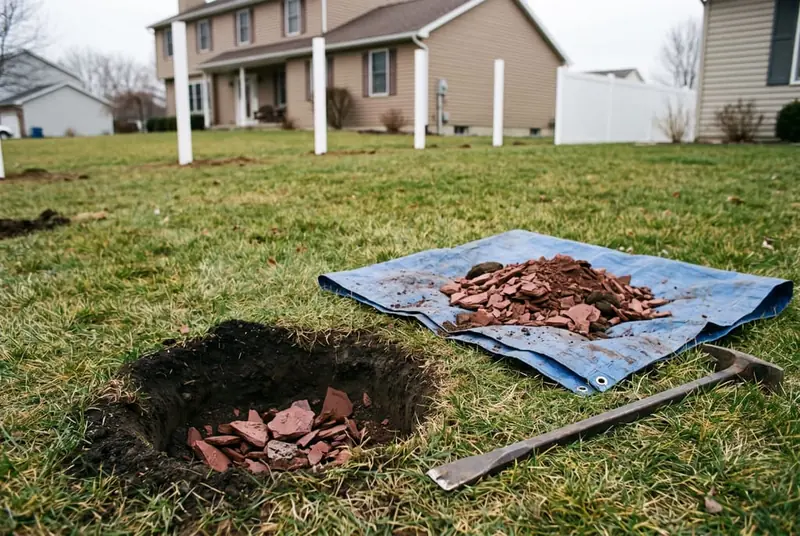
What’s under a Lansdale backyard?
The U.S. Geological Survey describes the bedrock under Lansdale as fractured shales and sandstones of the Brunswick Group and Lockatong Formation, tilted down toward the northwest. Those layers break into flat, dark-red plates. Weathered near the surface, they become the soils we dig through on most North Penn jobs.
Four soil series cover most of what we see in Lansdale, North Wales and Montgomeryville. They behave very differently:
| Soil | What it is | What it means for a post hole |
|---|---|---|
| Penn | Formed from Triassic red shale; bedrock usually 20 to 40 in down; shale fragments up to 50% of the subsoil | Red, shaly digging that gets harder with depth; the auger often stalls before 3 ft |
| Croton | Poorly drained shale-belt soil with a fragipan 15 to 25 in down that perches water in late winter and early spring | Holes fill with water in March and April; posts can sit in wet ground for weeks |
| Readington | Moderately well drained shale soil with a fragipan 20 to 36 in down | Easier digging than Penn, but water can collect on the pan after long rains |
| Lansdale | Well-drained loam from arkosic sandstone and conglomerate, bedrock about 3.5 to more than 5 ft down | Usually the easiest digging; the series was named here in 1905 |
USDA Official Soil Series Descriptions. Your yard may have fill, or a mix of these.
Yes, there is a soil series called Lansdale, established in Montgomery County in 1905. Ironically, it’s the friendly one. The red shale is the one that gives fence crews trouble.
Why does my post hole hit red rock?
Because in Penn soils, rock is the expected result. With bedrock commonly 20 to 40 in down and the subsoil up to half shale fragments, a hand auger or a small power auger will often stop somewhere between 2 and 3 ft. That’s shallower than the depth we want for a fence post in this climate.
Montgomery Township’s deck-building guide sets footings at least 36 in below undisturbed grade, and that’s the frost benchmark we use around here. A fence post that stops short of it is more likely to be lifted by frost, especially a gate post carrying a heavy gate.
What we do when the auger stops
- Break it out. Weathered shale is layered and fractured, so it usually comes apart with a rock bar, a heavier auger with carbide teeth or a small breaker. That’s slower and costs more labor than digging loam, and it’s one reason quotes vary from one street to the next.
- Shift the post. Moving a line post a few inches along the fence can land it in a softer seam. Post spacing has some room in it; corners and gates have less.
- Use the rock. Where solid rock is truly too shallow to get through, a post set into a hole drilled into sound rock and grouted can hold better than a deep post in loose fill. We decide this hole by hole.
Why does my yard stay soggy every spring?
If your lawn squishes from February into April and dries out by June, you probably have Croton or Readington soil over a fragipan. A fragipan is a dense, brittle layer that water barely passes through. Rain and snowmelt soak down to it and stop, so the soil above it stays saturated through late winter and early spring.
That matters for fences in two ways. Saturated soil holds a post less firmly, so a fence can lean after a wet spring. And water sitting around a post through freeze-thaw cycles is what frost heave feeds on: the wet soil freezes, expands and grips the post, and over a few winters a shallow post can work its way up.
Setting posts in wet ground
- Dig through the pan where we can, so water has somewhere to go instead of pooling in the hole.
- Put gravel in the bottom of the hole to drain the base of the post.
- Crown the concrete above grade so water runs away from the post instead of collecting against it.
- Leave a gap under privacy panels so they aren’t sitting in wet sod.
- Where the whole yard is wet in spring, consider vinyl or aluminum posts, which don’t rot, over wood posts in the ground.
Timing your fence around the ground
The shale belt changes through the year. In deep winter the top few inches can freeze hard, which slows digging. In late winter and early spring, fragipan yards are at their wettest, and a crew working in standing water makes a mess of the lawn. Late spring through fall is usually the easiest digging on these soils, and we schedule around the ground when we can.
Don’t skip the utility call
Pennsylvania requires a PA One Call (811) request at least 3 business days before you dig, and the Public Utility Commission names fence posts as a project that may need one. It’s free. When a contractor does the digging, the ticket goes in the contractor’s name. The system handled more than 1,095,000 tickets in 2025.
One more thing that hits the North Penn area hard: rock doesn’t move out of the way of a buried cable the way soft soil does. When a post location lands near a marked line, we move the post, not the line. Lines that 811 doesn’t mark, such as a buried invisible dog fence or other private lines you put in yourself, are on you to point out, so mention them before we start.
What this means for your project
- Budget for the ground. Two identical fences can take different amounts of labor in Montgomeryville and Lansdale because of what’s under them.
- Heavy gates need the best posts. Put the gate where the digging is deepest if you have a choice.
- Choose fence styles that forgive a little movement. Split rail and aluminum tolerate small shifts better than long runs of tight privacy panels.
- Watch the first spring. If a post moves, it usually shows by the first thaw. Our workmanship warranty covers our installation.
If you already know your yard is rocky or wet, tell us when you book the free estimate. We look at the ground while we measure and build it into the quote, so the price reflects your yard, not a guess.
Common questions
How deep should fence posts be in Lansdale?
We aim for the 36 in frost benchmark Montgomery Township uses for footings, deeper for gate posts. Where shale stops us short, we break it out or drill and grout into sound rock rather than leave a shallow post.
Why did my neighbor’s posts go in easily when mine hit rock?
Soils change over short distances here. One yard can be Lansdale loam with bedrock 3.5 ft or more down while the next is Penn shale with rock at 20 in, and many lots also have construction fill. Each hole is its own answer.
Will a wet spring push my new fence out of the ground?
Not if the posts are set deep, drained at the base and crowned at the top. Shallow posts in saturated fragipan soils are the ones that heave.