
Short answer
No backyard fence is built to survive the core of a tornado like Ida’s EF-2, which hit Upper Dublin with winds near 130 mph in 2021. A fence can be built to ride out the edges of big storms and be easy to repair afterward. That means posts set at least to the 36 in local frost benchmark, heavier end and gate posts, styles that let wind through, a plan for nearby trees, and standard sections you can replace one at a time.
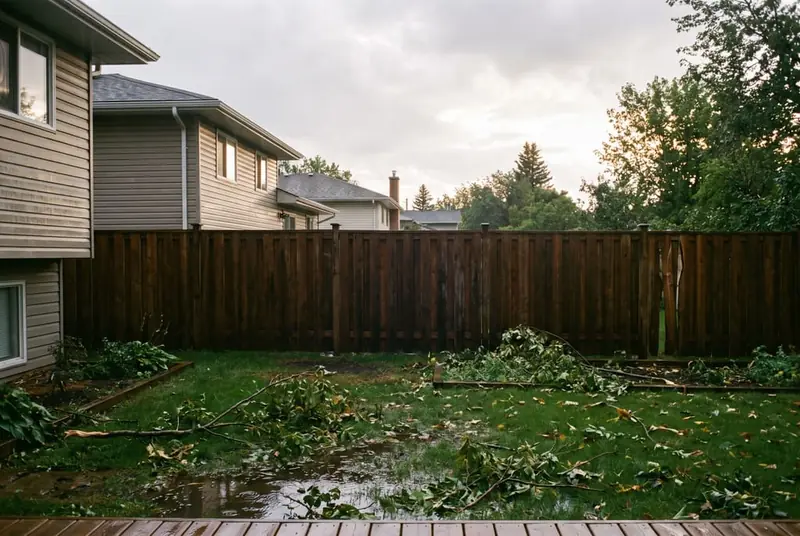
What the last decade of storms did here
| Storm | What happened locally |
|---|---|
| Ice storm, Feb. 5, 2014 | PECO’s second most damaging storm ever; more than 180,000 Montgomery County customers lost power, mostly from falling limbs |
| Severe storms, June 3, 2020 | Top gust of 76 mph; three deaths in Montgomery County, one in Lower Moreland; more than 130,000 customers without power; part of a Lansdale apartment complex’s roof torn off |
| Tropical Storm Isaias, Aug. 4, 2020 | Wissahickon Creek at Fort Washington reached 15 ft |
| Remnants of Ida, Sept. 1, 2021 | EF-2 tornado with peak winds estimated at 130 mph from Upper Dublin (Fort Washington) to Horsham; county rainfall averaged 8.25 in; the Wissahickon gauge hit 17.74 ft |
Sources listed below.
Ida’s tornado followed the Route 309 corridor from Whitemarsh through Upper Dublin into Horsham, with significant damage in Ambler, Fort Washington and Willow Grove. It took the roof off Upper Dublin’s township building on Loch Alsh Avenue, a woman died when a tree fell on her home, and PECO sent close to 45 trucks into the township.
Three forces run through that list: wind, falling trees and limbs, and water. A fence that holds up here has to be planned for all three.
Wind: why solid fences go first
A 6 ft solid privacy fence is a sail. Every square foot of board or panel catches wind, and all of that load ends up at the posts. An open fence such as aluminum picket, split rail or chain link lets most of the wind pass and carries far less load in the same gust. That doesn’t mean you can’t have privacy. It means building a privacy fence that can carry the load:
- Heavier posts where the load collects. Ends, corners and gate posts take the most force. We reinforce gate posts on vinyl fences and use heavier terminal posts on chain link.
- Let some air through. Board-on-board or shadowbox designs, with boards alternating on both sides of the rails, stay private from most angles while letting part of the wind pass.
- Keep a gap at the bottom. It costs nothing in privacy and lets water and wind-blown debris pass under the fence.
- Respect the height cap. Most townships here top out at 6 ft in back yards. Adding a solid topper over that adds wind load and can put you out of compliance.
Posts and footings: where storms are won or lost
Fences rarely snap in the middle of a panel. They lean or lie down because the posts moved. Montgomery Township’s building guide sets footings at least 36 in below undisturbed grade, and that’s the depth we treat as the local minimum for fence posts in concrete. Gate posts go deeper.
Water makes this worse. Ida dropped an average of 8.25 in of rain across the county, and a post sitting in saturated ground has less grip just when the wind is pushing hardest. In the North Penn area, many yards sit on shale soils with a dense layer 15 to 36 in down that holds water. Gravel at the base of the hole and concrete crowned above grade help those posts drain. Our shale digging guide has more.
Trees: the part no fence design fixes
In the 2014 ice storm most of the damage came from limbs, and in 2021 a falling tree took a life in Upper Dublin. No fence stops a falling oak. What you can do is plan for it:
- Look up before you lay out the fence. If a large tree leans toward the line, consider routing the fence or using an easy-to-repair style along that stretch.
- You may trim a neighbor’s limbs that hang over your property, back to the property line. Trees on the boundary are generally treated as jointly owned.
- Fences usually fall under the "other structures" part of a homeowners policy, often set at around 10% of the dwelling coverage. Read your own policy; this isn’t insurance advice.
Who pays when a neighbor’s tree comes down on your fence depends on the facts, and we cover it in a separate answer.
Build it so it’s easy to fix
After a big storm, every fence crew in the county is busy at once. A fence that can be repaired in sections gets back up sooner.
- Pick standard sizes. Stock panel widths and heights are easier to match than a custom one-off.
- Keep a few spares. Extra pickets, boards or a spare panel in the garage turn a broken bay into a one-hour fix.
- Know what you have. Keep your contract with the brand, color and style of the fence. It helps with matching, and with an insurance claim.
- Photograph it. A few dated photos of the finished fence make a storm claim simpler.
Water: Ida’s other lesson
Along the Wissahickon and Sandy Run, Ida’s damage was as much water as wind. The creek gauge at Fort Washington reached 17.74 ft, nearly the top of the gauge’s 18 ft measuring range; the creek leaves its banks at about 12 ft. A solid fence across a low spot catches debris and acts like a dam. Several townships ban fences in floodplains, swales or watercourses outright. Our creek and floodplain guide goes through them.
Rebuilding after a storm
- Make the yard safe first. Stay clear of downed wires and call the utility.
- Photograph the damage before anything is moved.
- Call your insurer before you sign for a full replacement.
- Check whether the rebuild needs a permit. Montgomery Township requires one for new or replacement fences, and Upper Dublin’s fee schedule lists new and replacement fences together.
- Request a PA One Call (811) ticket at least 3 business days before any new post holes, even if you’re reusing the old line.
If a storm has already taken part of your fence down, we can look at whether to repair the damaged sections or rebuild, and how to build the new line stronger. Mention the storm when you request the free estimate.
Common questions
Is vinyl or wood better in high wind?
Both fail at the posts first, so the footing matters more than the material. Wood can be repaired a board at a time; vinyl needs reinforced posts at gates and ends. See vinyl or wood for local winters.
Will my insurance replace a fence after a storm?
It depends on your policy, the cause and your deductible. Fences usually fall under "other structures" coverage. Ask your agent; this isn’t insurance advice.
Should I take my fence down before a hurricane or tornado warning?
Not practical for a permanent fence. Secure loose gates and remove anything hanging on the fence, such as planters or decorations, that could become debris.