Short answer
Both hold up here when the posts are set right, because freeze-thaw mostly attacks the posts, not the panels. Vinyl won't rot or need stain and runs about $45–75 per foot installed for 6 ft privacy. Pressure-treated pine runs $40–65 and cedar $45–70, and both need sealing. On the wet fragipan soils around Lansdale and North Wales, post depth and drainage matter more than which material you choose.
What a Montgomery County winter does to a fence
The trouble starts underground. Croton soils on the North Penn shale belt have a dense fragipan 15 to 25 in down that perches water in late winter and early spring, and Readington soils have one at 20 to 36 in. When that wet layer freezes, it grips whatever sits in it. A post that stops short of the 36-in frost benchmark used locally gets lifted a little with each freeze, and a fence that was straight in November leans by April.
Above ground, the threats are ice and wind. The Feb. 5, 2014 ice storm was PECO's second most damaging on record, with more than 180,000 Montgomery County customers out, mostly from falling limbs. The June 3, 2020 storms brought gusts to 76 mph. A fence has to survive a branch landing on it and a solid wall of panels catching wind.
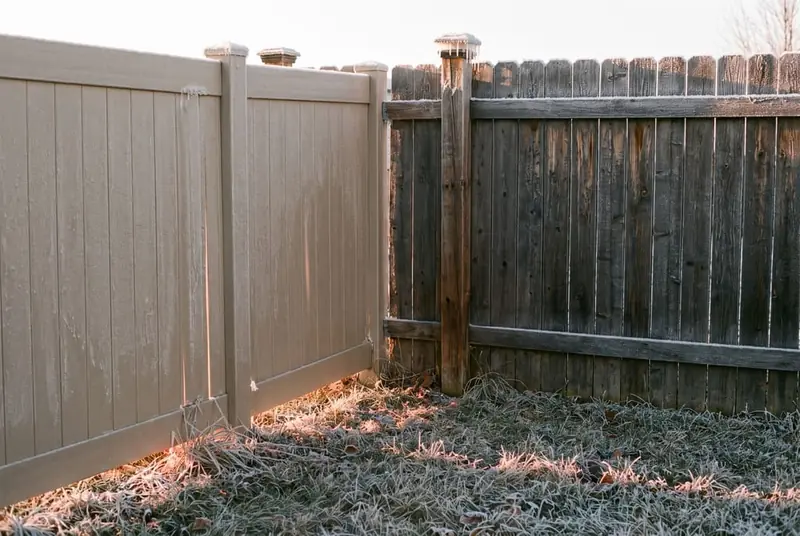
Vinyl and wood, side by side
| Vinyl privacy (6 ft) | Wood privacy (6 ft) | |
|---|---|---|
| Installed price per foot | $45–75 | $40–65 pressure-treated pine; $45–70 cedar |
| Moisture | Doesn't rot or absorb water | Ground-contact treated pine and cedar resist rot; boards still weather and need sealing |
| Cold | Gets stiffer in hard cold; a heavy limb or a thrown chunk of ice can crack a panel | Flexes and dents rather than cracking |
| After damage | Replace the damaged panel or rail section | Replace individual boards; easier to patch after a limb strike |
| Upkeep | Wash it | Stain or seal on the schedule the product maker recommends |
| Looks over time | Stays the same color | Weathers to gray unless stained |
Prices are our installed ranges for residential fences before gates, removal and permits.
Wood in wet ground
Wood's weak point is the post at the soil line, where it stays damp. On a wet, low lot over fragipan, we set posts in concrete below frost depth so they sit solid, and we keep boards off the soil so they can dry between rains. Cedar resists decay naturally; pressure-treated pine relies on its treatment. Either one lasts longer when it isn't sitting in water all spring.
Vinyl in cold and wind
Vinyl doesn't care about wet ground, but it does care about how it's built. Panel wall thickness, rail profile and reinforcement all matter, and we reinforce gate posts so gates don't sag out of latch after a winter of swinging. Solid vinyl panels catch wind the same way solid wood does, so post depth matters just as much.
Which we'd lean toward
- Low, wet yard that stays soggy into April: vinyl, or aluminum if you don't need privacy. Neither rots.
- Lot under big old trees: wood. A limb strike usually means a few new boards instead of a new panel.
- Want zero upkeep: vinyl, or composite at $110–160 per foot if you want a wood look.
- Tightest budget for privacy: pressure-treated pine, sealed and kept clear of the soil.
Every fence we install carries our 76-month workmanship warranty. At the estimate we'll look at how your yard drains in spring before we recommend a material.
Common questions
Does vinyl crack in the cold?
It gets stiffer in hard cold, so a sharp impact, like a falling limb or a chunk of ice thrown by a snowblower, is more likely to crack it in January than in July. Normal freezing doesn't hurt it.
Will frost heave affect vinyl and wood the same way?
Yes. Heave happens to the post in the ground, whatever is bolted to it. That's why we set posts in concrete below the local frost benchmark of 36 in.
Can you install a fence in winter here?
Often, unless the ground is frozen hard. See the best time of year to install a fence in southeast PA.