Short answer
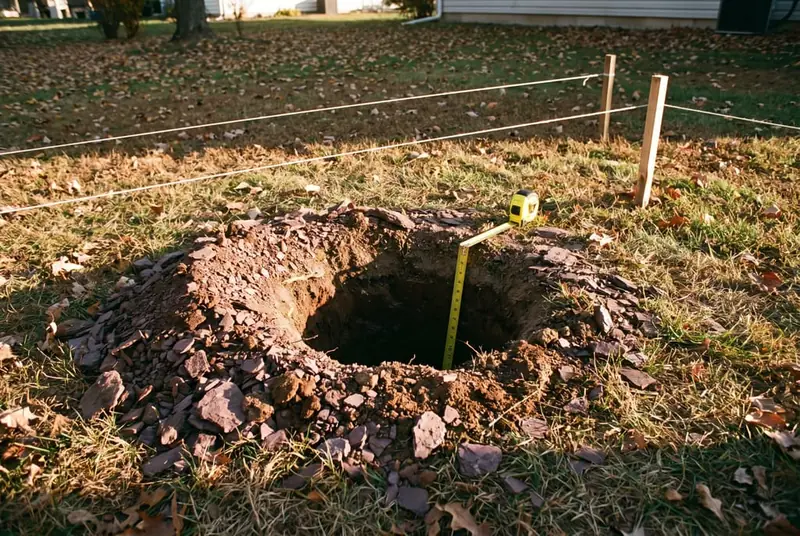
Plan on at least 36 in. That's the frost benchmark Montgomery Township uses for deck footings under the 2018 IRC (36 in below undisturbed grade), and it's the depth we set fence posts to in concrete around here, with gate posts deeper. Around Lansdale and North Wales, the shale belt can put bedrock 20 to 40 in down, which changes how the hole gets dug, not how deep it needs to go.
Where the 36-inch number comes from
We didn't find a township in our area that sets a minimum post depth in its fence ordinance. The useful local number comes from building code: Montgomery Township's deck guide, written to the 2018 International Residential Code, puts footings at least 36 in below undisturbed grade. That's the frost line people here work to, and a fence post that stops short of it is the post most likely to lift.
Why posts heave in this part of the county
Frost heave needs cold and water. Much of the North Penn area sits on soils that hold water at exactly the wrong depth. Croton soils on the Triassic shale belt have a dense fragipan 15 to 25 in down that perches water in late winter and early spring. Readington soils have a fragipan at 20 to 36 in. A shallow post sitting in that saturated layer gets gripped by freezing soil and jacked up a little each cycle. Setting the bottom of the post below that zone and below the frost line is what stops it.
What you hit when you dig
| Soil | What it's like | What it means for a post hole |
|---|---|---|
| Penn | Formed from Triassic red shale; bedrock usually 20–40 in down; shale fragments up to 50% of the subsoil | The dark-red, shaly ground around Lansdale and North Wales. Augers slow down; fractured shale usually has to be broken out to reach depth. |
| Lansdale | Well-drained loam weathered from sandstone and conglomerate; bedrock about 3.5 to more than 5 ft down. The series was established in Montgomery County in 1905. | Easier digging and good drainage. Holes usually reach 36 in without hitting rock. |
| Croton | Poorly drained; fragipan 15–25 in down perches water in late winter and spring | Wet holes in spring. Depth and concrete matter most here. |
| Readington | Moderately well drained; fragipan 20–36 in down | Can look dry on top and be wet at post depth in March. |
Soil descriptions from USDA official soil series descriptions.
Under all of it, the U.S. Geological Survey describes the bedrock beneath Lansdale as fractured shales and sandstones of the Brunswick Group and Lockatong Formation, tilted toward the northwest. Fractured is good news: the rock usually breaks out in plates instead of stopping the hole cold.
How depth changes by fence type
- Privacy fences (wood, vinyl, composite): 6 ft solid panels catch wind, so posts go in concrete below the frost line.
- Gate posts: deeper and heavier than line posts, because a gate puts leverage on its post every time it swings.
- Chain link: heavier terminal posts at ends, corners and gates, with line posts no more than 10 ft apart.
- Aluminum and split rail: lighter and more open, but still set below frost so the rails stay level.
Before any hole: PA One Call
Pennsylvania law requires a call to 811 at least 3 business days before you dig, and the Public Utility Commission names fence posts as a project that may need a ticket. When you hire a contractor, the contractor places the ticket. PA One Call processed more than 1,095,000 tickets in 2025, so plan for the wait.
At your free estimate we look at the ground you're on, wet low spot or shale ridge, and set the post plan to match. Our guide to digging fence posts in North Penn shale goes deeper on the rock.
Common questions
Is 24 in deep enough for a 4 ft fence?
It stops 12 in short of the 36-in frost benchmark used here, so the post is more likely to heave in a wet winter. We set posts in concrete below frost depth whatever the height.
What happens if you hit rock at 2 ft?
On the shale belt that's common. Fractured shale can usually be broken out with a bar or a rock auger until the hole reaches depth. Solid rock is rarer and gets handled post by post.
Do fence posts need concrete?
We set posts in concrete below your township's frost depth. On wet fragipan soils, that keeps them from loosening as the ground freezes and thaws.